You can learn a lot about a company’s AI progress by asking someone to walk you through a job that has actually changed. A licence count will tell you what has been bought. A demonstration will show you what is possible. The walkthrough reveals whether anyone has made it useful.
That distinction matters when the board is asking what the investment has delivered and the answer is a collection of promising examples, enthusiastic individuals and a fairly substantial software bill.
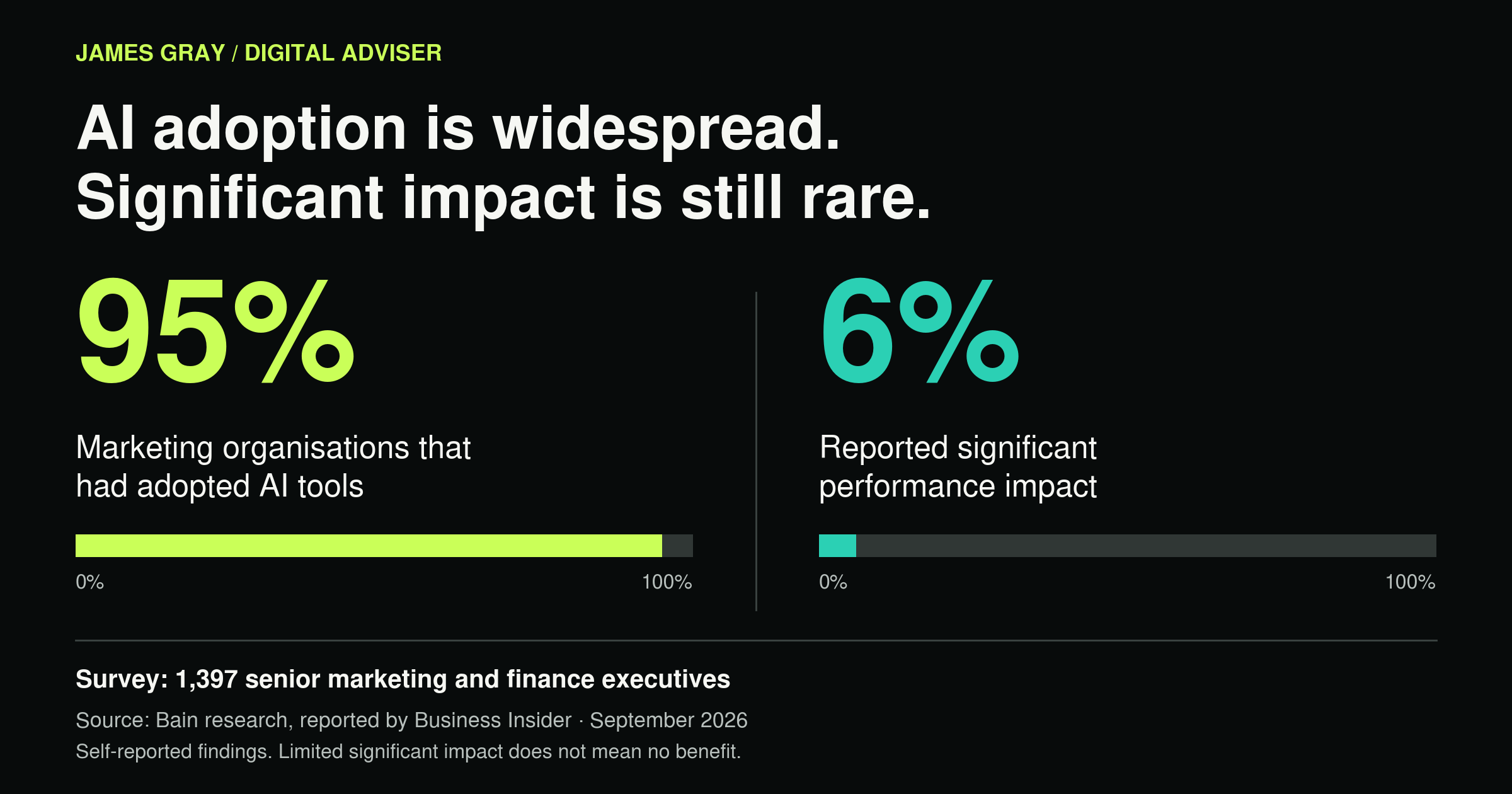
In Business Insider’s September reporting on Bain research, 95% of marketing organisations had adopted AI tools, while only 6% reported significant performance impact. The study surveyed 1,397 senior marketing and finance executives. Those are reported survey findings, not a controlled test proving that AI succeeds or fails.
The gap is worth investigating. It certainly doesn’t mean every organisation outside that 6% has wasted its money. Early gains can be modest, poorly measured or concentrated in a few tasks. But when AI use is spreading and nobody can explain how the business has improved, another round of licences deserves some scrutiny.
Look beyond the person using the tool
An individual can become considerably quicker at producing something without the organisation becoming quicker at getting it done.
Consider a hypothetical marketing team using AI to draft campaign content. The first version arrives sooner, but the brief is still vague, the product information is scattered across several files, and approval involves three people who disagree about what the campaign is meant to achieve. The copywriter has saved time. The campaign may still launch on exactly the same date.
Worse, easier production can create a larger queue for everybody downstream. If the team makes twice as many variants, somebody has to assess them, check the claims, approve the assets and make sense of the results. A faster first step can leave a slower overall process.
When I talk about embedding AI, I mean making an appropriate use of it repeatable within a real business process. The input is understood, the output has an agreed quality standard, someone is accountable for the decision, and there is evidence that the revised process is worth keeping.
That can be quite a modest change. It doesn’t require an agent army or a slide entitled “Our AI Transformation Journey”. It does require a better answer than “people seem to like it”.
Choose a workflow you can explain
My starting point would be a recurring job with enough volume or friction to justify attention. Preparing a client update, qualifying an enquiry, reviewing a set of customer comments or assembling a campaign brief are examples to investigate, not automatic recommendations.
Before selecting a tool, follow the work from beginning to end. Where does the information come from? What happens when it is missing? Which judgements require experience? Where does the job wait for someone else? What would a genuinely better result look like for the person receiving it?
This is also the moment to ask whether the task should exist in its current form. Automating a report that nobody reads is a peculiar way to demonstrate strategic progress.
There is research behind looking at the process. McKinsey’s March 2025 survey found workflow redesign was the organisational attribute most strongly associated with reported EBIT impact among the 25 it examined. That is an association in self-reported data, not proof that redesign guarantees a return. It is, however, a useful reason to examine how work happens before expanding access to tools.
For a smaller business, the practical version might be one team, one workflow and a bounded trial. The aim is to learn enough to make the next investment decision properly.
Train people on their work, including the awkward bits
A general introduction to prompting can help people get started. It is a fairly thin substitute for showing them how to use AI well in the job they actually do.
A sales colleague needs to recognise an unsupported product claim. A marketer needs to notice when an apparently convincing customer insight has no evidence behind it. A manager needs to know when a neat summary has removed the disagreement that should inform the decision.
The training should therefore use representative work, agreed source material and realistic failure cases. People need practice spotting a bad result, correcting it and deciding when to abandon the AI-assisted route altogether.
Research involving Harvard Business School and BCG examined 758 consultants and found substantial gains on tasks within the tested AI system’s capabilities. The researchers described a jagged technological frontier: performance varied by task. It was a study of particular tasks and a particular model, not a forecast for every company’s return on AI.
The implication I would draw is that capability needs to be tested against your own work. Confidence with an interface is useful. Judgement about whether to trust its output is more useful still.
Give the process an owner who can change it
An AI enthusiast can introduce a promising tool. They may have no authority to change the approval process, agree the data access, remove an unnecessary handover or decide what happens to the time saved.
That leaves the person pushing adoption responsible for an outcome they cannot control.
The workflow needs a business owner who can make those decisions, with appropriate support from the people responsible for technology, information security and specialist advice. The arrangement should be proportionate to the work. An internal drafting assistant and a system taking customer-facing actions warrant different levels of scrutiny.
Write down which inputs are permitted, who checks the output, what requires approval, and where responsibility sits when something goes wrong. Make those instructions available where the work happens. If a colleague has to interpret a policy document every time they begin a routine task, the operating model needs improving.
There is a trade-off here. Review and control add time. They can also prevent expensive mistakes. The answer is to design them around the consequences of failure, then include that effort in the assessment of value.
Count the checking, the rework and the cost
If you want to claim that AI has made a process more efficient, establish what it costs and how it performs before changing it.
Measure the whole job: preparation, production, checking, correction and handover. Include the time spent maintaining instructions and source material. Record quality against an agreed standard, rather than asking whether the output looks impressive.
The business outcome will depend on the workflow. It might be a shorter customer response time, fewer avoidable mistakes, a better-qualified enquiry or faster delivery of work that was already valuable. Producing more material is only helpful if there is a reason to produce it.
Time saved also needs a destination. Releasing capacity can be valuable without reducing payroll, but it isn’t automatically a cash saving. If the plan is to give people more time for customer research, improvement work or account development, say so and check whether that actually happens.
An honest business case includes licence costs, implementation, training, review and ongoing upkeep. It also gives you permission to stop. Some uses of AI will turn out to be more trouble than they are worth, and discovering that in a small trial is a perfectly respectable result.
Expand what survives ordinary working conditions
A successful demonstration usually benefits from good inputs, an attentive operator and a convenient example. Everyday work is less accommodating.
Test what happens when the brief is incomplete, the source information conflicts, the output is wrong or the regular user is on holiday. Can another colleague follow the process? Can someone identify the fault and recover without starting again? Is there a usable fallback?
Once the trial is producing reliable results, document the working method and give the team a way to report problems. Review it after changes to the tool, the task or the source material. A method that worked last month still needs someone to own it this month.
This is where you can decide whether another team should adopt the same approach. Similar-looking jobs may have different information, risks or standards. Reusing a proven method makes sense; assuming its performance transfers unchanged does not.
Where an AI readiness audit earns its keep
If you already have AI in several corners of the organisation, the useful question is how well those activities connect to your business priorities and working practices.
Start with the free organisational AI readiness assessment. It looks across direction, people, governance, data, technology and measurement, and gives you a directional view of where to investigate. No email address or sign-up is required. One person’s answers are a starting point, though, rather than evidence of how the whole organisation operates.
A company-wide review goes further by comparing those perceptions with actual workflows, tools, responsibilities and evidence of value. It should help you decide which opportunities deserve investment, what needs fixing before expansion, and which activities can stop.
That is the purpose of my AI Adoption Alignment Review: to give leaders an independent view of the choices ahead and a practical order in which to tackle them. It is a business and customer-experience review, not a substitute for specialist legal, regulatory or security assurance.
If your organisation has plenty of AI activity but the return remains difficult to explain, let’s discuss the review. Bring the awkward examples as well as the successful demonstrations. They are usually the ones that make the next decision clearer.