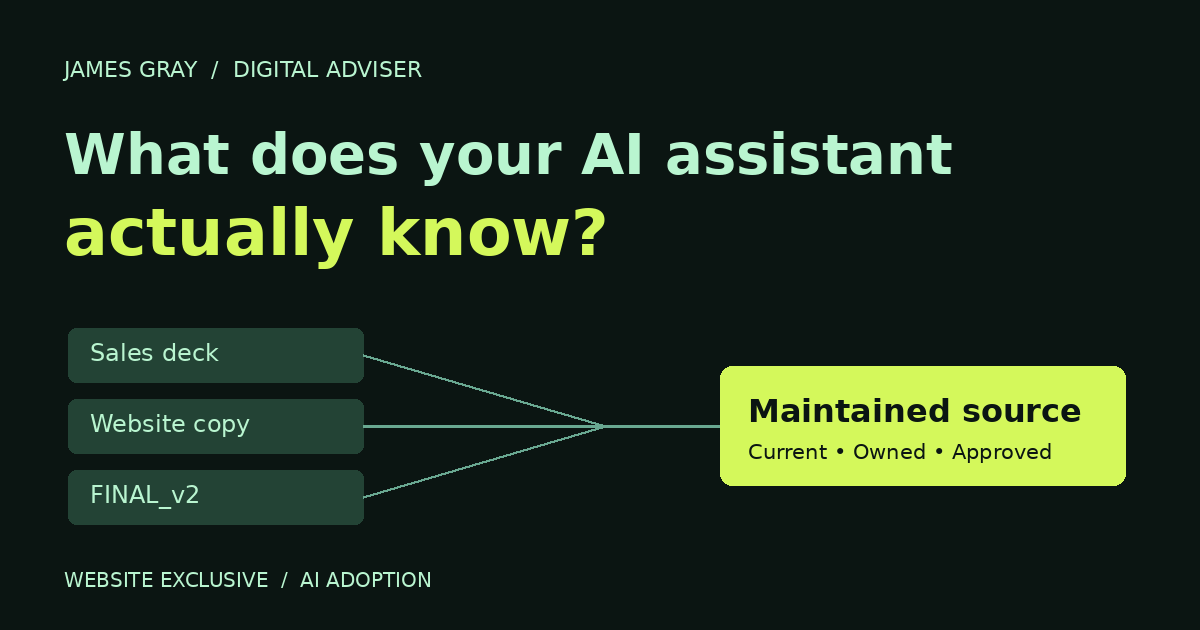
Ask three colleagues for the latest description of a service and you may receive a sales deck, a web page and a document with FINAL in its filename twice. All three will sound plausible. The interesting conversation begins when you ask which one the business would stand behind in a customer meeting.
Now connect an AI assistant to the collection and ask it to prepare a proposal. It might make the inconsistency easier to work with, or it might turn it into a beautifully written answer nobody has actually approved. Before blaming the prompt, I’d take a look at the information we have asked the system to trust.
Start with a job that needs an answer
An organisation-wide knowledge programme can become a very large project with a very vague finish line. I’d begin with one recurring task and work backwards from what a good answer needs.
Imagine an assistant helping a sales team answer service enquiries. It needs to know what the service includes, where it is available, which promises require approval and when to refer the enquiry to a specialist. It probably does not need unrestricted access to every customer contract the company has ever signed.
That gives the team a manageable starting set of information and a way to judge whether it is useful. For each source, record who owns it, what it applies to and how someone can establish that it is current. Where two sources disagree, get the business to resolve the disagreement. The model should not be asked to arbitrate an internal argument nobody else has finished.
More context can bring more confusion
There is a reassuring instinct to upload everything, on the basis that the answer must be in there somewhere. Finding the right passage and using it correctly are separate problems.
Anthropic’s explanation of contextual retrieval shows how passages can lose meaning when separated from their surrounding documents. Its later context engineering guidance also emphasises selecting useful information within a finite context budget. These are technical discussions of system design, not a prescription for buying a particular knowledge platform.
The business implication I’d draw is straightforward: keep the qualifications attached to the claim. A service available in one country should not become a global promise because its regional heading went missing. A historical result should retain its date. A policy exception should remain recognisable as an exception.
A shorter, maintained source can be more useful than an impressive archive of material with uncertain status. Test that proposition on your own task before commissioning a grand reorganisation of the company’s documents.
Make ownership part of the answer
A source of truth needs someone with the authority and time to keep it true. That responsibility cannot end when the first documents have been uploaded.
For a small team, the arrangement may be modest. The service owner checks the description after a change, the commercial owner approves claims and the assistant’s maintainer makes sure retired material is no longer being used. What matters is that the process survives ordinary staff changes and busy weeks.
I’d also make the route for reporting a bad answer obvious. A colleague who spots a wrong statement should know whether to correct the source, flag retrieval behaviour or escalate a permission problem. Otherwise the same error gets fixed repeatedly in individual chats while the underlying material remains untouched.
Test questions people would rather avoid
A set of friendly demonstration questions tells you whether the assistant can follow the happy path. Build another set around uncertainty.
Ask about a discontinued service. Ask for a claim the business cannot substantiate. Ask about a region excluded from the offer. Include a question the system should refer to a person rather than answer. Then inspect both the response and the source it used.
Success can include an appropriate admission of uncertainty. For a customer-facing workflow, “I need someone to confirm that” may be a much better result than a persuasive paragraph built from the wrong document.
Check permissions separately. Information being useful does not make it appropriate for every role or every tool. The people responsible for data access and specialist review should define those boundaries; a prompting workshop will not settle them.
Budget for keeping knowledge useful
The ongoing effort belongs in the business case. Someone will need to maintain content, test changed answers and investigate errors. If the projected saving depends on nobody ever doing that work, I’d revisit the projection.
There may also be a benefit before AI enters the picture. A team that can agree what it sells, what evidence supports its claims and who owns the answer has improved its working practices already. The assistant then has a clearer job to support.
This connects directly to the people and governance questions in why AI adoption stalls. The AI readiness assessment includes data and knowledge foundations, and can help identify where to investigate first.
If you want to examine that picture across a team, the AI Adoption Alignment Review looks at the working evidence behind it. I’d start by asking to see a real answer, the information behind it and the person responsible for keeping that information current. That is usually a more revealing conversation than comparing everyone’s favourite prompt.