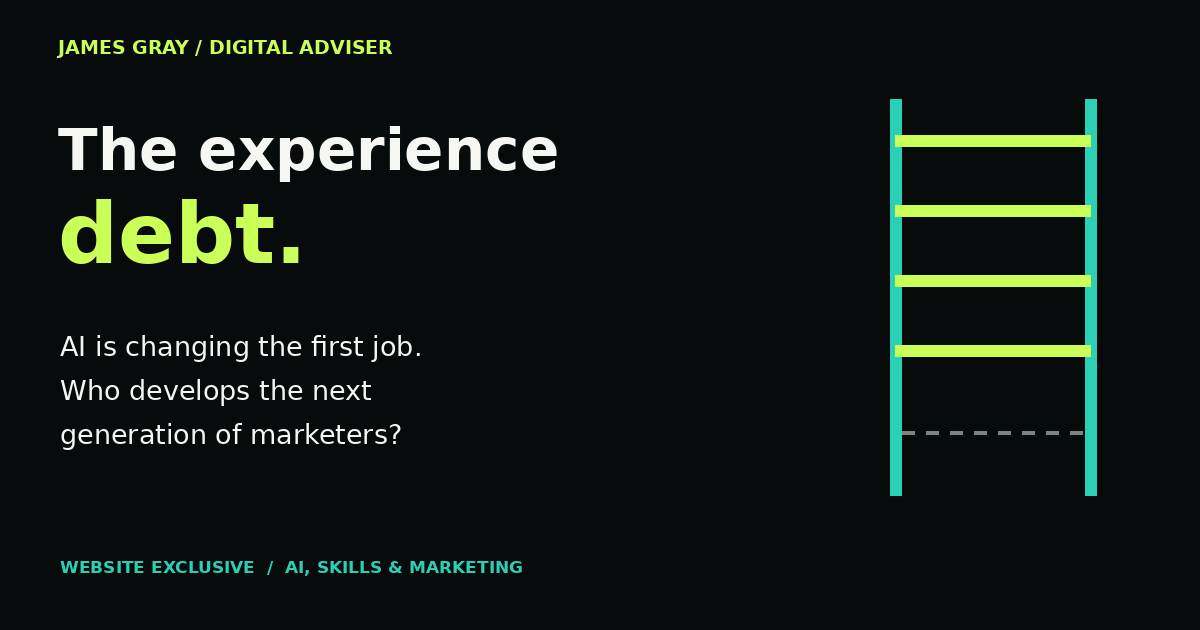
There’s a peculiar bit of maths emerging in marketing departments. We want candidates with five years of experience, while steadily automating the work that used to give them year one.
I’ve spent more than two decades working in digital and marketing, long enough to remember when much of what we now consider a perfectly normal career path barely existed. Plenty of us learnt on the job. We made mistakes, had our thinking challenged by someone more experienced, and gradually figured out why a promising idea on a slide could turn into an absolute car crash in the real world.
Over the years, I’ve pushed to bring apprentices and interns into agencies and teams because I know how valuable that start can be. I’ve also met graduates full of enthusiasm whose courses hadn't quite caught up with what the industry actually does on a Tuesday morning. That gap was frustrating before generative AI arrived. It’s a considerably bigger problem when employers begin removing the work that helped people close it.
We’re creating what I’d call experience debt: a short-term saving achieved by taking development opportunities out of the system. Like technical debt, it can remain pleasantly invisible until you need something important and discover nobody has learnt how to do it.
The jobs debate is more complicated than the headlines
In September 2026, Gartner predicted that by 2030 AI will allow the majority of high-performing marketing teams to eliminate the traditional bottom rungs of the corporate ladder. Its research with 1,303 senior leaders also found that 18% of marketing leaders had eliminated certain functional roles through automation, while 16% had created new roles. Those are changes already being reported. The 2030 claim is a forecast, and we should treat it as one.
Before anyone starts writing the obituary for every graduate scheme in Britain, there’s some important context. UK government analysis with LinkedIn found hiring was down 14% year-on-year in April 2026. Entry-level hiring was broadly moving with the wider market, rather than collapsing on its own. Thirty of the 38 entry-level occupations tracked were declining, but the authors were explicit: that overlap between weakening hiring and growing AI capability is not proof that AI caused the decline.
Across the Atlantic, Stanford’s Digital Economy Lab reported in August that employment among 22–25-year-olds in highly AI-exposed US occupations was around 19% below where it would have been had it kept pace with similarly aged workers in less-exposed occupations. The researchers found no widespread economy-wide displacement, and they cautioned that this difference isn’t a causal estimate of AI’s impact.
So we need a little less certainty from both camps. It’s premature to say AI has wiped out junior jobs. It’s equally complacent to assume the career ladder will look after itself while we remove its lower steps.
The boring work was doing more than producing work
Think about the early days of a marketing career. Auditing a website, pulling apart a campaign report, drafting a content brief, checking a set of search queries, listening to a client explain a problem that doesn’t quite match the one in the brief. Some of it is repetitive. Much of it is exactly the sort of thing AI is getting very good at handling.
But those jobs have a second purpose that rarely makes it into a utilisation report. They teach people how things fit together. You notice that a perfectly decent landing page converts badly because the traffic was never relevant. You discover that a dashboard can be technically correct and commercially useless. You learn to ask what a customer is trying to achieve before happily creating 40 pieces of content nobody asked for.
AI can generate an SEO audit or a convincing campaign recommendation in moments. The challenge for a new starter is knowing when the answer is plausible rubbish, or when the original question was wrong. That sort of judgement comes from exposure, feedback, mistakes and, ideally, somebody taking the time to explain why.
There’s a commercial irony here. A business might celebrate removing a couple of junior roles from this year’s budget, then spend a small fortune recruiting experienced people in three years because it never developed any of its own. Gartner’s HR research has already warned about that exact talent-pipeline risk.
We need to redesign the first job, not retire it
I’m certainly not arguing for a return to the days of making a junior spend three afternoons formatting a spreadsheet just because that’s what we endured. If an AI tool can do a tedious task accurately in three minutes, crack on. My concern is what replaces the learning that used to happen along the way.
Here’s how I’d approach it with a marketing team.
Audit the learning we’re automating away
Whenever we automate a task, ask two questions: how much time does it save, and what did someone learn by doing it? If a junior no longer builds the first draft of a keyword map, get them to interrogate the AI version against customer intent, real search behaviour and commercial priorities. Give them the opportunity to challenge the output and explain their reasoning to a strategist who knows the territory.
Time saved is useful. Skills lost should appear somewhere in the business case too.
Let juniors get closer to the decisions
Junior people are often kept away from the interesting conversations until they’ve earned their stripes doing production work. AI gives us a chance to change that. Bring them into discovery. Let them hear a client describe the problem in their own words. Ask them to recommend an approach, explain what evidence supports it, and name the trade-offs. Then have somebody senior challenge the recommendation properly.
They don’t need to be right on day one. They do need opportunities to become right for good reasons.
Protect mentoring time as deliberately as delivery time
AI can remove a decent chunk of preparation, reporting and admin. Some of that reclaimed time ought to fund coaching, review and exposure to real work. Otherwise the productivity saving simply gets filled with another ten things on the to-do list, and the supposed transformation delivers a busier team with an even thinner talent pipeline.
Measure progress through the complexity of problems people can handle, the quality of their decisions and how independently they can work. The number of AI-generated assets they can push through the door tells you very little about whether they’re becoming a better marketer.
Stop expecting education to solve a problem industry keeps changing
I’m a supporter of apprenticeships, internships and getting younger people into digital careers early. I’m also conscious that some marketing courses struggle to keep pace with the real-world demands of search, analytics, CX, automation and now AI. We can complain about that over another conference coffee, or we can help do something about it.
Give students real briefs. Invite them into workshops. Offer feedback on what the industry actually values. Work with training providers on live skills rather than yesterday’s channel checklist. And keep opportunities open to people whose route into the industry doesn’t involve a conventional degree. Digital was built by plenty of people who learnt their craft in less conventional ways.
Even the apprenticeship numbers deserve a closer look. England’s provisional figures for August 2025 to April 2026 show starts up 8.7% overall, but down 5.4% among under-19s. Those figures cover all sectors, not just marketing, and they’re another reminder to look beneath the reassuring headline.
There’s an opportunity here, if we’re prepared to pay attention
New starters are entering an industry with tools I couldn’t have dreamt of early in my career. They can explore ideas, build prototypes and test assumptions faster than I ever could. That should be exciting. A properly supported junior marketer with access to good AI tools and experienced colleagues could learn an enormous amount in their first year.
But employers have to make a conscious choice to develop that person. The labour market won’t automatically create tomorrow’s strategists, marketing directors or agency leaders just because we bought everyone a licence and called it enablement.
If I were running an AI adoption programme in a marketing function, I’d want a learning-impact assessment alongside the usual productivity measures. For every workflow we automate, identify the capability it used to develop, decide where that experience will now come from, and give someone responsibility for making it happen.
There’s a broader point here about organisational readiness. I’ve written before about why AI strategies collapse when businesses ignore people, process and governance. The career pipeline belongs in that same conversation. If you’re thinking seriously about embedding AI across a team, my AI Adoption Readiness Assessment is a useful starting point for the wider discussion.
And before the next leadership meeting celebrates another heroic reduction in hours spent on junior tasks, I’d ask one rather awkward question: who’s going to have the experience to lead this team when the current lot move on?
Because it would be a spectacularly daft outcome if we made marketing more efficient today, only to discover we’d forgotten to train tomorrow’s marketers.
For more on turning individual AI use into a supported organisational practice, read Why AI adoption stalls, and how to embed it into your organisation.
About the author: James Gray is an independent digital strategy adviser and author of The Daily Dose of Digital. He writes about the practical decisions behind digital strategy, customer experience, AI adoption and search.